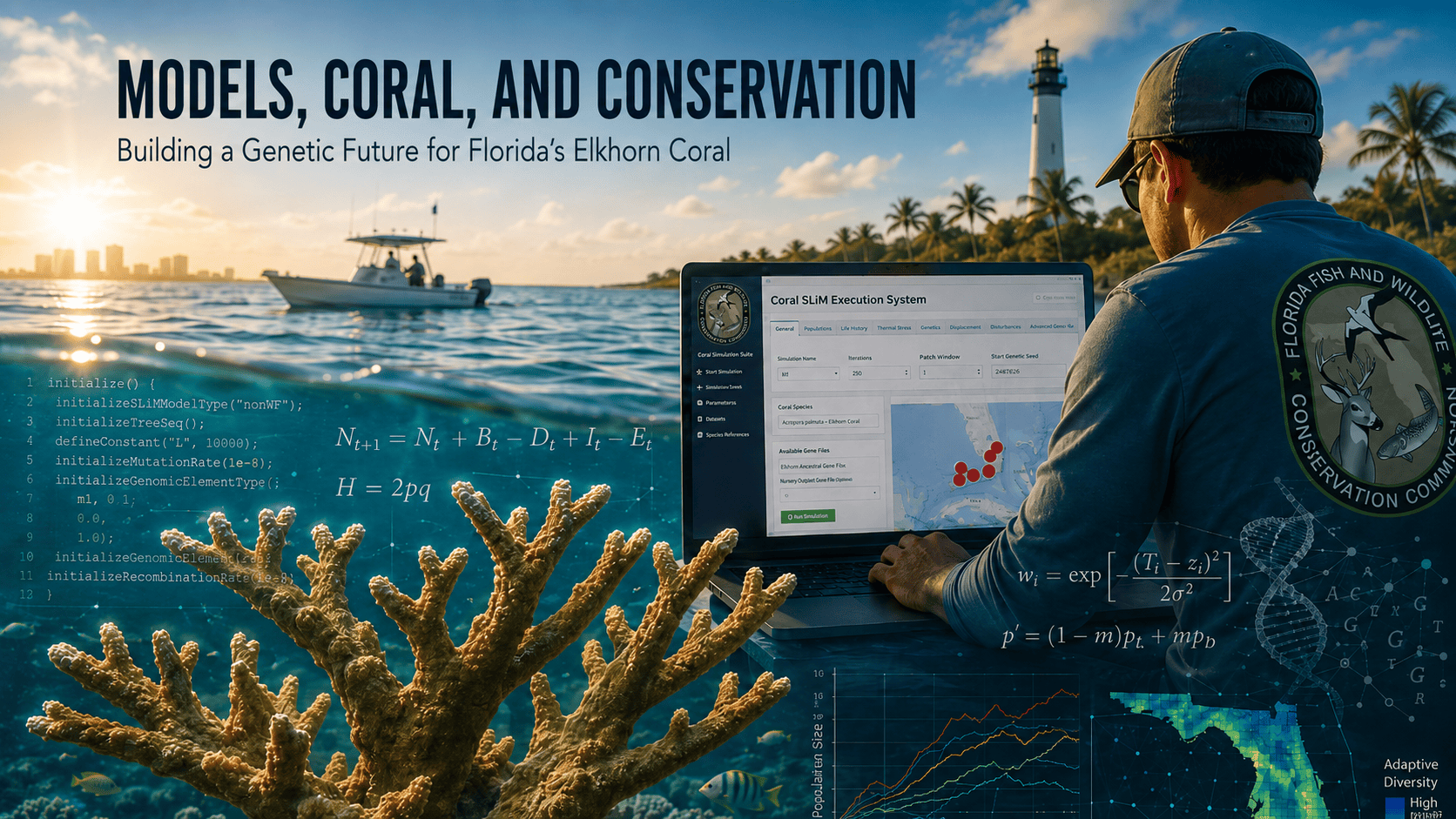
How my work in conservation, genetics, and biotechnology came together in the Coral SLiM Execution System—and why computational modeling may help us make smarter decisions for one of Florida’s most important reef-building species.
Most people who know me know that I work in conservation. What they may not know is how much my work has evolved in recent years—or how often my days now move between biology, genetics, mathematics, databases, computer programming, and conservation strategy.
Recently, I was given the opportunity to add another dimension to that work by contributing to our conservation genetics efforts, with a particular focus on one of Florida’s most iconic and imperiled reef-building corals: elkhorn coral, Acropora palmata.
That assignment has led me into one of the most technically challenging—and personally satisfying—projects I have worked on: developing what I now call the Coral SLiM Execution System, a forward-time eco-evolutionary simulation platform designed to explore how genetics, demography, environmental stress, disturbance, spatial connectivity, and assisted gene flow might interact over decades of coral restoration. What began as a relatively straightforward evolutionary model inspired by SLiM has grown into a much more ambitious .NET-based scientific prototype.
And there is a reason I think this project is worth talking about outside the walls of the office. It represents something I increasingly believe about conservation:
When populations become small, fragmented, genetically constrained, and exposed to rapidly changing environments, simply asking whether we can restore more organisms is no longer enough. We also have to ask which organisms, carrying which genetic variation, moved where, in what combinations, and under what future conditions give a population its best chance of persisting.
That is ultimately the question this project is trying to help us explore.
The Species Behind the Model
Before getting into code, genetics, or equations, it is important to understand the organism.
Elkhorn coral (Acropora palmata) is not just another coral species.
It is one of the foundational architects of Caribbean coral reefs.

Elkhorn coral. NOAA Fisheries imagery.
Its broad, antler-like branches can form large thickets in shallow water. Historically, those structures created extraordinary three-dimensional habitat for fishes and countless other reef organisms. Along with staghorn and several massive reef-building corals, elkhorn helped construct Caribbean reef ecosystems over thousands of years. NOAA describes A. palmata as one of the most important corals in the Caribbean.
Those complex reef structures matter to people as well as wildlife. Healthy reefs contribute to fisheries, biodiversity, tourism, shoreline stability, and the dissipation of wave energy before it reaches coastal communities.
But elkhorn coral has undergone an extraordinary decline. NOAA reports that the species is now at less than 3% of its former abundance, following decades of disease, ocean warming, bleaching, habitat degradation, pollution, and other pressures. It remains listed as threatened under the U.S. Endangered Species Act. (fisheries.noaa.gov)
And Florida’s populations are particularly important. Recent restoration research describes a Florida population that had already become severely depleted and spatially fragmented before the extreme 2023 marine heatwave. That event then caused another dramatic loss of elkhorn coral and genetic diversity on Florida’s reefs. (pmc.ncbi.nlm.nih.gov)
So when we talk about restoring elkhorn coral, we are not simply talking about putting more coral fragments into the ocean. We are talking about preserving and rebuilding an evolutionary population. And that changes the problem considerably.
From Conservation Programming to Conservation Genetics
My own work has increasingly lived at the intersection of disciplines. I have always enjoyed the engineering side of science—the challenge of taking messy biological questions and turning them into something that can be represented by data, algorithms, models, software, or reproducible analytical workflows.
Conservation genetics has made that intersection particularly exciting. Because genetics changes the scale at which you think.
A coral colony is something you can see. A reef is something you can map. But genetic diversity, allele frequencies, recombination, selection, genetic load, ancestry, adaptive potential, and gene flow are processes occurring beneath the visible ecosystem. Yet over generations, those invisible processes can strongly influence what the ecosystem eventually looks like.
That is what fascinated me about this assignment. It wasn’t enough for me to build something that counted corals. I wanted to build something that allowed the population to evolve.
Working closely with my boss, Mike T. (Lead Geneticist at FWRI), has been particularly valuable in that regard. His extensive genetics background has given me a much deeper appreciation for the biological questions that a useful conservation model actually needs to address. Our conversations have forced me to think beyond whether an algorithm works computationally and toward the much harder question:
Does the biological logic make sense?
That distinction is enormous. A programmer can make numbers move. A scientific programmer has to make sure they move for defensible reasons.
Starting With SLiM
The conceptual foundation of the project began with SLiM, one of the most important forward genetic simulation frameworks in modern population genetics.
SLiM was originally developed to efficiently simulate evolutionary processes including mutation, selection, recombination, and linkage. It later expanded substantially, including support for non-Wright-Fisher and broader eco-evolutionary modeling. (academic.oup.com)
Forward simulation is exactly what it sounds like. Instead of starting with populations today and attempting to reconstruct their history backward, we define a biological population at some starting point and allow it to move forward through generations.
Individuals survive. Individuals die. Individuals reproduce. DNA is inherited. Recombination creates new chromosomes. Mutations arise. Some variants may be beneficial. Some may be neutral. Some may be harmful. Environmental conditions change. Selection changes which individuals contribute disproportionately to future generations. Populations exchange migrants. Storms happen. Heat stress happens. Disease happens.
And the population that exists at year 50 is the accumulated result of everything that occurred during years 1 through 49.
That framework is extremely powerful because conservation itself is fundamentally forward-looking. We cannot change what happened to Florida’s reefs fifty years ago. What we can influence is what happens next.
Then I Decided to Build Something Bigger
My earliest model was considerably simpler than what exists today. But as we continued working through the genetics, I realized that I wanted a system in which the genetics would not be isolated from everything else occurring in the population.
A genotype does not exist in a vacuum. Its consequences depend upon the environment. The environment varies spatially. Populations exchange larvae. Disturbances do not occur uniformly. Restoration introduces additional individuals and potentially new ancestry. And randomness matters enormously when populations become small.
So the project evolved. Eventually I began translating the concepts I had been experimenting with into a larger C#/.NET scientific simulation architecture. That became the Coral SLiM Execution System.
The name is deliberate. This is a SLiM-informed engine, not an attempt to replace SLiM itself. SLiM remains an extraordinarily sophisticated population-genetic simulation platform. My goal has been to carry forward many of the concepts that make forward evolutionary modeling so useful and build a specialized experimental environment around our particular coral-restoration questions.
The Coral SLiM Execution System
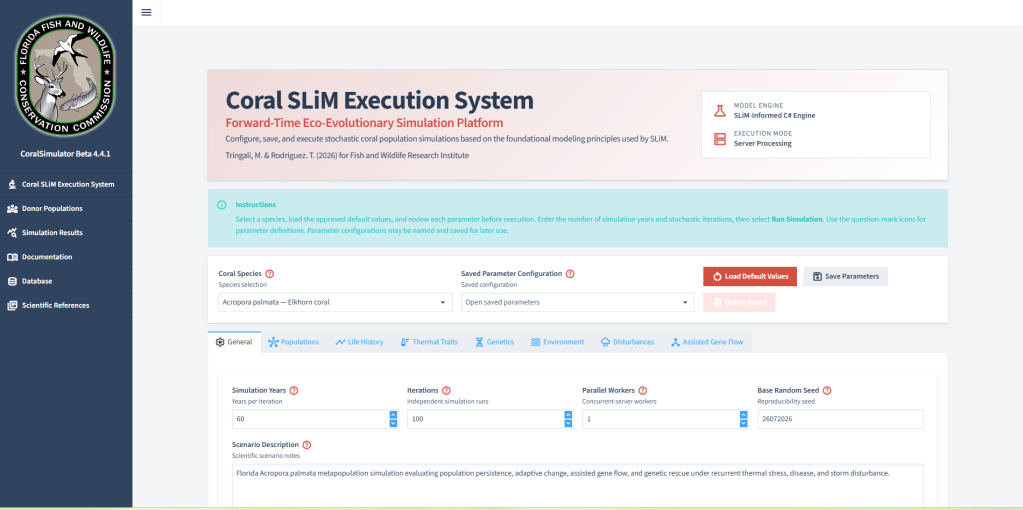
The current Coral SLiM Execution System interface. The model exposes biological assumptions instead of burying them in code, allowing species, populations, life-history parameters, thermal traits, genetics, environmental variables, disturbances, and assisted gene flow to be configured as parts of a common experiment.
One of the things I am proudest of is how far the model has come architecturally. What was once essentially a genetic experiment is becoming a forward-time eco-evolutionary simulation platform.
The application now organizes model parameters into several interacting domains:
Populations. Life history. Thermal traits. Genetics. Environment. Disturbances. Assisted gene flow.
That organization is intentional. Rather than thinking about a coral population as one equation, the model treats it as a collection of biological processes interacting through time.
A simulation may run for 60 years. It may be repeated 30 times, 100 times, or more. Each repetition receives stochastic events and demographic outcomes.
That means I am not asking the model:
“What will the population be in 60 years?”
That would imply a certainty the system cannot provide.
I am asking a better question:
“Under these biological assumptions and this restoration strategy, what range of evolutionary and demographic outcomes repeatedly emerges?”
That is an important difference.
The Mathematics Under the Coral
A model like this eventually becomes mathematics expressed through software.
At the simplest level, population size from one time step to another can be thought of conceptually as
where:
- is population size,
- represents recruitment or births,
- represents mortality,
- represents immigration,
- represents emigration.
But an evolutionary model cannot stop there. The individuals contributing to do not necessarily contribute equally. Their genotypes matter. Their traits matter. Environmental conditions matter. And chance matters.
So behind that seemingly simple population trajectory is a much larger system.
Genetics as an Inheritance Process
Consider a locus with two alleles, and .
If the frequency of allele is , then
and under ideal Hardy-Weinberg assumptions, expected genotype frequencies begin as
The quantity
is also a useful representation of expected heterozygosity at a biallelic locus.
But the interesting part begins when populations no longer satisfy those simple assumptions. Selection changes reproductive contribution. Migration changes allele frequencies. Drift becomes powerful in small populations. Mutation introduces new states. Recombination rearranges existing variation.
That is why forward simulation becomes useful. Instead of solving one equilibrium equation, we allow the evolutionary process to unfold.
Natural Selection Is an Algorithm Too
Suppose individuals differ in an adaptive trait —for example, some modeled component of thermal tolerance.
One useful conceptual way to describe selection is to compare that trait with the environment experienced during that year.
A simplified fitness relationship might resemble:
where:
- is relative fitness,
- is an individual’s trait value,
- represents the environmental condition,
- determines how strongly mismatch is penalized.
The exact biological implementation can become considerably more complicated, but the important concept is straightforward:
If environments change, the relative value of genetic variation can change with them.
An allele that does very little under one thermal environment could become important under another. That is evolution.
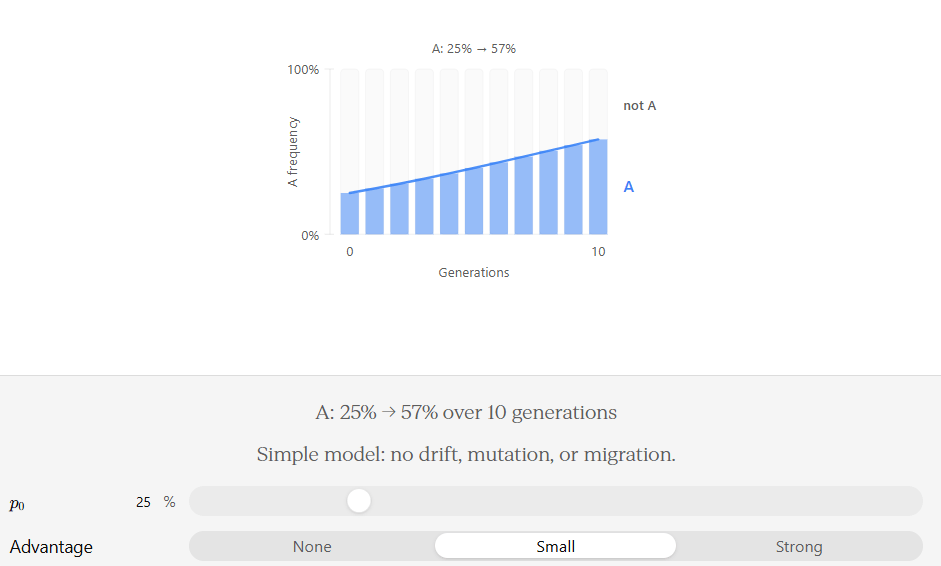
The model therefore isn’t simply carrying DNA along as decorative metadata. Genetics must eventually influence outcomes, or there is little reason to simulate it.
Mutation, Recombination, and New Genetic Combinations
The engine also treats inheritance as more than copying a single “genetics score” from parent to offspring.
Conceptually, an offspring genome comes from parental genomes that have undergone recombination.
A highly simplified representation might look like:
where represents recombination and represents new mutation.
That distinction matters. Evolution does not operate on static labels. Every generation creates new combinations of existing genetic variation. Mutation can introduce additional variation. Natural selection and drift then determine which variants survive into later generations.
This is one of the areas that required some of the hardest engineering work: getting the genetics to behave as part of a coherent inheritance system while still making the simulation computationally practical.
Gene Flow: One of the Most Important Pieces
This brings me to perhaps the most interesting conservation component of the project:
Assisted Gene Flow
Assisted gene flow is the intentional movement of genetic variation among populations to help increase diversity or adaptive capacity.
Conceptually, if a local population carries allele at frequency , while a donor population carries it at frequency , migration can be represented in its simplest form as
where is the proportion of genetic contribution coming from the donor population.
That tiny equation contains an enormous conservation question.
How much gene flow?
From where?
Into which population?
At what time?
How frequently?
What happens to donor ancestry afterward?
Does diversity increase?
Does adaptive potential increase?
Does the introduced ancestry persist?
Does selection remove portions of it?
Does the intervention reduce extinction risk?
Could too much migration overwhelm locally useful genetic structure?
These are not questions that can responsibly be answered by saying, “More diversity is always better.” Population genetics is rarely that simple.
Why Assisted Gene Flow Is Especially Interesting for Elkhorn Coral
This is not merely theoretical.
Scientists have already demonstrated assisted gene flow in Acropora palmata using cryopreserved sperm from geographically distinct populations.
In one landmark experiment, elkhorn coral eggs from Curaçao were fertilized with cryopreserved sperm from Florida and Puerto Rico. Researchers genetically confirmed interpopulation offspring, demonstrating that cryopreservation could provide a practical mechanism for transporting genetic diversity between geographically isolated populations. (pmc.ncbi.nlm.nih.gov)
That is extraordinary from a conservation-genetics perspective. It means that genetic material potentially can cross distances that natural larval dispersal may rarely or never bridge.
But demonstrating that something can be done is different from deciding how it should be used. And that is where modeling becomes extremely interesting.
A simulation gives us a virtual laboratory in which we can explore strategies before treating every assumption as a real-world intervention.
Simulating Assisted Gene Flow as a Restoration Strategy
Within my model, assisted gene flow can be treated as an explicit intervention rather than an abstract concept.
That means we can begin asking questions such as:
What happens if donor genetic material is introduced early?
What if intervention occurs only after the recipient population has declined?
What if donor contribution is small?
What if it is comparatively large?
What if several introductions occur?
How quickly does donor ancestry become diluted?
What happens to heterozygosity?
What happens to adaptive variation?
What happens to deleterious genetic burden?
What happens when an apparently successful genetic strategy encounters repeated thermal events or severe disturbances?
Those are much more useful questions than simply asking whether assisted gene flow “works.”
The goal is to identify conditions under which it may work best.
The Environment Has a Vote
One mistake I wanted to avoid was building a genetics model in which genes determine everything. They do not. A perfectly interesting genotype cannot survive an environment that exceeds its biological limits.
So the Coral SLiM Execution System also separates environmental variables from disturbance events.
That distinction is important. An environmental variable describes the state of the environment through time—temperature, for example. A disturbance is an event imposed upon that background state: an extreme heat event, cold event, storm, disease episode, or another acute perturbation.
You can imagine environmental temperature as
and then a disturbance adding an additional temporary shock:
where may be zero during most years and large during an extreme event.
This distinction lets the model ask a biologically important question:
Can a population that performs reasonably well under gradual environmental change survive when extreme events are superimposed on that trend?
Those are not equivalent challenges.
Small Populations Make Randomness Important
Another reason I built the simulation around repeated stochastic iterations is that small populations behave unpredictably.
When thousands or millions of individuals exist, the law of large numbers can smooth some demographic randomness. When there are twenty individuals, losing three by chance matters. When there are six, it matters enormously.
The probability of persistence therefore cannot be represented adequately by a single simulation. So the system runs the scenario repeatedly.
Thirty iterations might generate thirty different outcomes despite identical parameter settings. One population might persist. Another might collapse. One may retain donor ancestry. Another may lose much of it through stochastic reproduction.
That is not a flaw in the model. That variation is part of the biology we are trying to understand.
Turning Hundreds of Simulations Into Something a Scientist Can Read
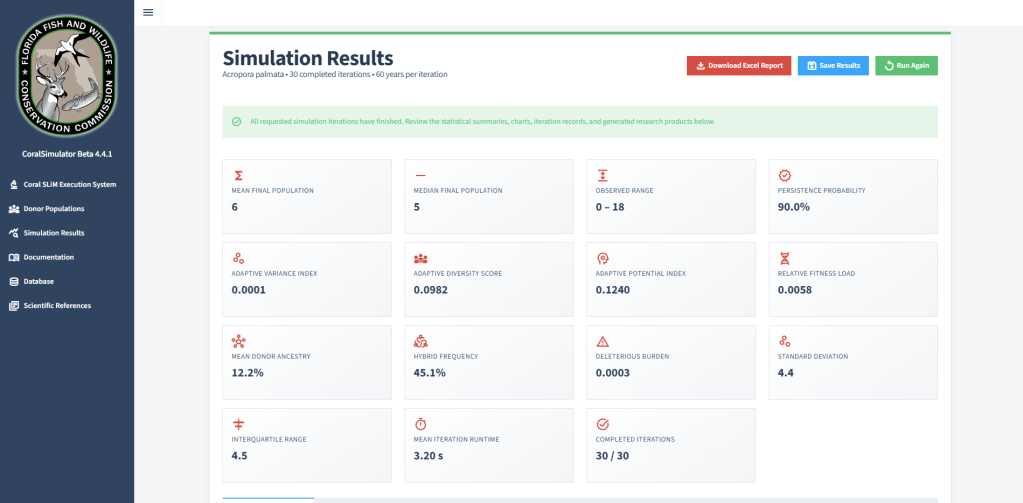
The results interface summarizes repeated stochastic simulations, including demographic and genetic measures rather than reporting population abundance alone.
This became another major part of the project. Running a simulation is easy compared with making its results scientifically interpretable.
So I began expanding the results architecture.
The current system reports demographic measures such as:
- mean final population,
- median final population,
- observed range,
- persistence probability,
- standard deviation,
- interquartile range,
alongside genetic and evolutionary measurements including:
- adaptive variance,
- adaptive diversity,
- adaptive potential,
- relative fitness load,
- donor ancestry,
- hybrid frequency,
- deleterious burden.
That is intentional. If an assisted gene-flow scenario produces 20% more corals but catastrophically reduces an important form of genetic variation, the population number alone does not tell the story.
Likewise, a scenario may have modest demographic benefits initially but substantially preserve adaptive diversity that becomes important later.
The model has to look at both.
Spatial Ecology: Genetics Has Geography
Another major evolution of the system has been adding spatial analysis.
Florida’s coral populations do not exist in one giant bucket. They occur along a geographically structured reef tract with different environments, histories, connectivity patterns, and disturbances.
So the latest versions of the application integrate spatial results using Esri mapping technology.
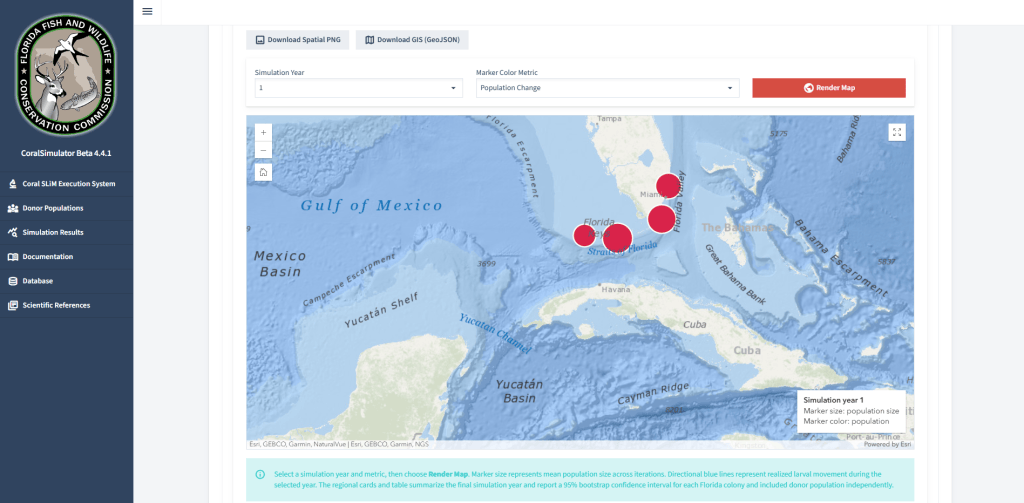
Spatial output from the model. Population and genetic results can be examined geographically across Florida reef regions and included donor populations.
This changed the way I thought about the simulation.
Instead of asking:
How is the population doing?
we can begin asking:
Where is it doing well?
Where is it failing?
Where is adaptive diversity being retained?
Where is donor ancestry moving?
Which populations may function as demographic or genetic sources?
Where might restoration effort have the greatest leverage?
That transition—from a population model to a spatially explicit metapopulation model—is an important one.
Larvae move. Genes therefore move. And once genes move, geography becomes part of evolutionary dynamics.
From a Simple Genetic Model to a Scientific Software System
It is difficult to explain how much work sits behind a screen like this.
Users see tabs, buttons, maps, charts, and numerical results. Behind them are hundreds of decisions.
How should a genome be represented?
How should loci be stored?
How should mutations propagate through a lineage?
How should chromosomes recombine?
How do you prevent impossible genotypes?
How should mortality interact with fitness?
What happens when a population reaches zero?
How should donor ancestry be inherited?
How should migration interact with reproduction?
How do you distinguish environmental pressure from an acute disturbance?
How do you make stochastic runs reproducible?
How do you parallelize simulations safely?
How do you summarize hundreds of runs without hiding variability?
How do you export results so another scientist can independently analyze them?
How do you expose enough parameters to make the model useful without producing an interface nobody can understand?
And perhaps most importantly:
How do you know whether a result that looks interesting reflects biology, mathematics, or a bug?
That last question keeps scientific programmers humble.
Reproducibility Matters
One seemingly minor field visible in the application is the random seed. It is not minor at all.
Randomness drives many simulation outcomes, but scientific experiments need to be reproducible.
A pseudorandom simulation therefore begins with a seed:
The exact random-number algorithm is an implementation detail, but the principle is simple: if the same model configuration uses the same deterministic pseudorandom sequence, investigators can reproduce an experiment.
That allows me to distinguish:
“This scenario produced a strange result.”
from
“This exact simulation run produced a strange result, and I can reproduce it.”
For scientific software, that difference matters.
Parallelization Became Necessary
Then comes computation.
One scenario may involve decades of:
- reproduction,
- inheritance,
- mutation,
- recombination,
- individual survival,
- environmental response,
- spatial migration,
- disturbance,
- ancestry tracking,
- statistical accumulation.
Multiply that by hundreds of individuals. Then dozens of loci. Then 60 years. Then 100 independent iterations. Then multiple restoration scenarios.
The workload grows quickly.
Conceptually, total computational work behaves something like
where
- = simulated years,
- = stochastic iterations,
- = simulated population size,
- = genetic complexity.
That is why the system now supports parallel workers and server-side execution.
The biological model and the software architecture had to evolve together.
Why I Chose .NET
Some people may reasonably ask:
Why build this in C# and .NET?
Because I wanted to explore whether serious scientific simulation could coexist with the engineering advantages of a modern enterprise application platform.
The engine can use strongly typed biological models. The web interface can expose experimental parameters. The execution layer can perform parallel server-side processing. SQL can preserve simulations and metadata. Results can be exported. GIS components can visualize spatial outcomes. And eventually, the same scientific engine can potentially support additional tools, workflows, or species models without rebuilding the entire application.
For me, this is where my backgrounds in programming and biological science really intersect.
I am not interested in software for software’s sake. I am interested in software as a scientific instrument.
A Model Is Not an Oracle
There is an important qualification I want to make. This system does not predict the future. Neither does any ecological model.
A model is a structured representation of assumptions. Its value comes from asking:
If these assumptions are approximately true, what consequences follow?
That makes parameterization, validation, sensitivity analysis, and biological review incredibly important.
The more sophisticated the software becomes, the easier it is to be impressed by its output. But a beautiful graph does not make an assumption correct.
That is one reason working collaboratively with geneticists and coral experts is so important. The code needs biology. The biology benefits from computation. Neither replaces the other.
Why Genetic Diversity Matters So Much Now
Florida’s elkhorn coral situation makes this especially urgent.
Recent research shows how restoration has sometimes succeeded in rebuilding genetically diverse spawning groups of A. palmata, allowing colonies originating from widely separated reefs to reproduce in proximity. Those efforts can restore opportunities for genetic recombination that would otherwise be extremely rare in severely depleted populations. (pmc.ncbi.nlm.nih.gov)
But the 2023 marine heatwave also illustrated something sobering: A restored population can be biologically successful for years and still encounter an environmental event severe enough to erase much of that progress. (pmc.ncbi.nlm.nih.gov)
That is one of the reasons I think genetics needs to be considered alongside restoration numbers.
We do not merely want coral. We want coral populations capable of persisting, reproducing, recombining, adapting, and continuing to evolve.
Conservation Is Ultimately About Keeping Options Open
That idea has stayed with me throughout this project.
Genetic diversity is, in one sense, biological optionality. A population containing more useful variation may possess more evolutionary routes through an uncertain future.
Not every variant will become important. Not every genotype will survive. Not every restoration intervention will succeed.
But eliminating variation permanently closes evolutionary doors.
Conservation genetics therefore forces us to think beyond individual animals, colonies, or even present-day ecosystems. We are protecting possibilities.
What I Hope This Model Eventually Helps Us Do
I would love to see the Coral SLiM Execution System mature into a framework capable of comparing realistic restoration strategies in ways that are useful to the people actually making conservation decisions.
For example:
Scenario A: Continue local propagation without assisted gene flow.
Scenario B: Introduce a small amount of donor ancestry.
Scenario C: Introduce donor genetic material periodically.
Scenario D: Target specific geographic populations.
Scenario E: Prioritize donor genotypes with particular modeled adaptive characteristics.
Then ask the same questions across all five:
What is persistence after 20, 40, or 60 years?
What happens under repeated thermal stress?
What happens to genetic diversity?
What happens to donor ancestry?
What happens to adaptive potential?
What happens to genetic load?
Which strategy is robust across many possible futures rather than merely excellent under one?
That last question may ultimately be the most important.
Because conservation decisions are made under uncertainty. The best strategy may not be the strategy that produces the highest outcome under one perfectly predicted future. It may be the strategy that performs reasonably well across many plausible futures.
And That Is Why Simulation Matters
A restoration action in the real world can take years or decades before its full evolutionary consequences become visible. A computer can explore many decades in minutes.
That does not make simulation superior to field science. It makes simulation a partner to it.
Field observations tell us what actually happened. Experiments help identify mechanisms. Genomics reveals variation. Population genetics gives us theory. Ecology provides context.
And simulation asks:
What happens when we put all of those pieces together and allow time to run forward?
That is the intellectual space I am trying to build with this project.
There Is Still a Lot of Work Ahead
The Coral SLiM Execution System is still a prototype. I consider that important to say publicly.
I am continually improving the genetic architecture, spatial analysis, environmental components, disturbance logic, reporting, validation, and scientific documentation.
There are still questions to solve. There will certainly be assumptions that need revision. There will be code that gets rewritten. There will probably be moments when a result forces me to go back through thousands of lines of logic to find one tiny biological or computational assumption that changed everything.
That is science. And, frankly, that is also software development. Neither advances in a perfectly straight line.
What the Project Has Meant to Me
Professionally, this project has allowed me to use almost every part of my background at once.
Genetics.
Biology.
Conservation.
Population modeling.
Statistics.
Biotechnology.
C#.
SQL.
GIS.
Scientific visualization.
And perhaps most importantly, collaboration.
There is something deeply satisfying about taking an idea discussed between scientists, turning it first into mathematics, then into algorithms, then into software, and finally watching a simulation population move across generations on the screen.
A few years ago, I would not have predicted that I would spend so much of my time thinking about recombination engines, donor ancestry, larval connectivity, thermal adaptation, genetic load, spatial population structure, and stochastic extinction probabilities.
I’m glad that I do.
Florida Is Worth the Effort
Those of us who live and work in Florida are surrounded by ecosystems that are remarkable precisely because they exist at the boundary between worlds.
Land and ocean.
Temperate and tropical.
Freshwater and saltwater.
Development and wilderness.
Our coral reef is another one of those extraordinary boundaries.
Elkhorn coral has been part of that system for thousands of years. Losing it would mean losing much more than an individual species. We would be losing one of the organisms responsible for physically building the habitat on which an entire community depends.
That is why conservation of Acropora palmata deserves extraordinary effort. Not because every intervention is guaranteed to work. But because doing nothing is itself a decision—and the recent trajectory of the species tells us what that decision may produce.
From Code to Coral
Sometimes conservation looks like a biologist underwater attaching coral fragments to a reef. Sometimes it looks like someone preserving gametes in a cryogenic laboratory. Sometimes it looks like genetic sequencing. Sometimes it looks like a meeting full of scientists arguing about assumptions. And sometimes conservation looks like a programmer sitting in front of a monitor late in the day wondering why an allele-frequency trajectory changed after generation 37.
I have come to appreciate that all of those activities can belong to the same mission.
The reef does not care whether an idea came from genetics, ecology, mathematics, or computer science. It only matters whether we use those disciplines wisely enough to give the species we are trying to conserve a better chance.
Looking Forward
I don’t know exactly where the Coral SLiM Execution System will ultimately lead. That is part of what makes the project exciting.
My immediate goal is to continue making the model more biologically defensible, more transparent, more reproducible, and more useful for exploring restoration strategies.
But I also see a larger possibility. The architecture behind this project does not fundamentally belong to one coral.
The same ideas—population structure, inheritance, selection, migration, environmental stress, disturbance, adaptive management, and uncertainty—exist throughout conservation biology.
If we can build good tools for evaluating those processes in elkhorn coral, pieces of that work may eventually help inform models for other populations, other species, or other restoration problems.
That is the future I find most compelling.
Not computers replacing conservation biologists.
Not models replacing field observations.
Not algorithms deciding what happens to wildlife.
Something much more powerful:
Biologists, geneticists, ecologists, programmers, and conservation managers using computation together to see possibilities that none of us could see as clearly alone.
One Final Thought
Conservation is often described as preserving what remains. I increasingly think that definition is incomplete.
We are also trying to preserve the ability of living systems to become something next.
Evolution does not stop because a species becomes threatened. Genes continue to recombine. Mutations continue to arise. Environments continue to change. Selection continues. Chance continues.
Our responsibility is not to engineer some perfect, frozen version of nature. It is to prevent human-caused decline from narrowing a species’ possibilities so severely that evolution no longer has enough material—or enough time—to work.
That is what makes genetics so powerful. And it is what makes this project personal for me.
I started with code. Then came populations. Then genomes. Then maps. Then disturbances, migration, ancestry, selection, and restoration.
And somewhere along the way, the project stopped feeling like simply another application I was building. It began to feel like a way of asking one of the most important questions we can ask in conservation:
What can we do today to give a species more evolutionary options tomorrow?
For Florida’s elkhorn coral, I hope the work we are doing helps us find some of those answers.
A note for readers
The Coral SLiM Execution System is an evolving research prototype. Simulation outputs represent outcomes under specified biological and mathematical assumptions; they are intended to support scientific exploration and hypothesis testing, not to replace empirical data, field experimentation, genetic analyses, or management review.
For readers who want to dig into the science behind the project, NOAA has excellent background material on elkhorn coral and assisted gene flow, and the SLiM literature by Philipp Messer, Benjamin Haller, and collaborators provides the foundation for modern forward-time evolutionary simulation. (fisheries.noaa.gov)

