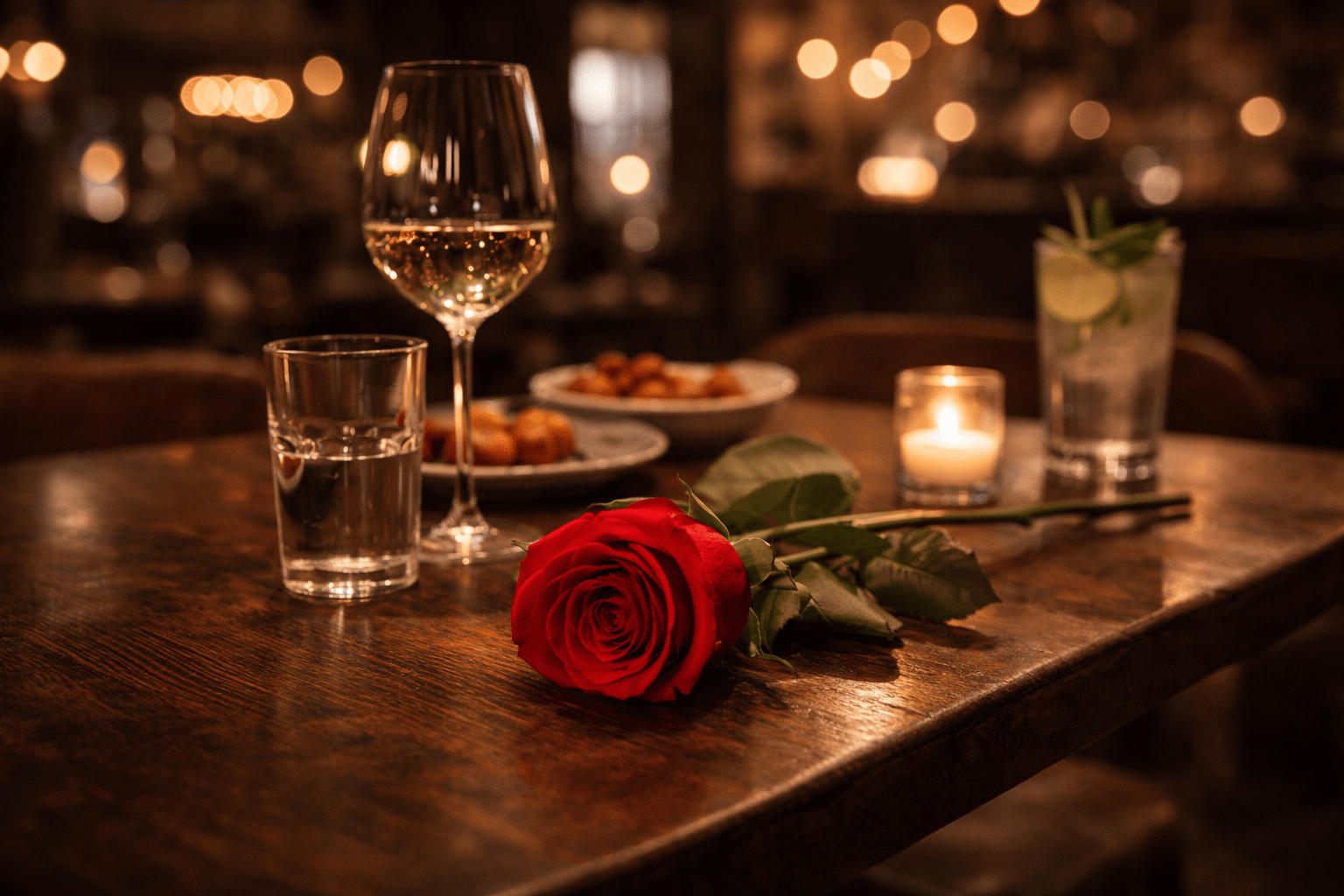
He told me about her like you tell a story you haven’t decided how to feel about yet—half-smiling, half-squinting at it, as if the meaning might shift depending on the light.
“She seemed… normal,” he said. Which, in this era, is already a kind of praise.
He did what people don’t always do anymore. He showed up with intention. Not extravagance—just something simple, almost old-fashioned. A rose. The kind of gesture that says, I’m here on purpose. The kind of gesture that risks being a little out of place in a world that prefers everything casual, deniable, uncommitted.
The first date began the way most do: polite, exploratory, a soft exchange of identities. Who are you, really? And can I see myself next to that?
There were meatballs. Croquetas. Drinks that arrived cold and left half-finished. The kind of small table that holds just enough—plates, glasses, a little expectation. Conversation moved easily at first. Light talk about his work, about hers. The ordinary scaffolding people build when they’re deciding whether to keep going.
He said he teased her a little—gently, he thought. The kind of teasing that, in his mind, builds a bridge rather than burns one. Confidence, wrapped in humor. Or so he intended.
At some point, he leaned just a bit further in. Asked about her past. Not prying, not interrogating—just enough curiosity to see what lived behind the surface. The kind of question that says, I’m actually here with you, not just passing time.
And then, after two croquetas and three drinks—without ceremony, without the emotional punctuation one expects at the end of even a mediocre evening—she stood up somewhere in the middle of it all and said she had to go.
Work.
A clean word. A reasonable word. A word that doesn’t invite argument.
He didn’t think much of it at first. Life happens. People have obligations. The world interrupts.
But later, the small digital confirmations began to arrive, quiet as falling dust.
Unfollowed.
Blocked.
Erased.
Not just a departure from the date, but a departure from possibility itself.
What fascinates me is not that she left. People leave all the time. Chemistry is a fragile, private calculus—often decided in silence long before it’s spoken aloud.
What fascinates me is the manner of the leaving.
There is, in modern dating, a kind of vanishing that feels almost artistic in its precision. No confrontation. No explanation. No loose ends—at least not for the one who disappears. It is an exit designed for efficiency, not for understanding.
It says: I have reached a conclusion, and you are not entitled to the reasoning.
To the one who remains, it creates a peculiar kind of echo.
Because now the mind goes to work.
Was it something I said?
Was it the tone? The timing? The rose?
Was it the questions—too soon, too direct?
Was there a moment I missed, a signal I failed to read?
The search begins for a mistake that might not exist in any meaningful way.
But here is the quieter truth—the one my friend came to, eventually, after the noise settled:
Not every ending is a diagnosis.
Sometimes it is simply a preference, or a feeling, or a private discomfort that someone else does not have the language—or the courage—to articulate.
And when a person chooses disappearance over explanation, they reveal something far more stable than a fleeting reaction to a joke or a comment.
They reveal their relationship to discomfort.
Some people will sit across from you and say, “This isn’t for me.”
Others will leave mid-sentence and close every door behind them, as if clarity were a burden they refuse to carry.
One is difficult.
The other is… informative.
There is, oddly enough, a kind of joy in that information.
Because imagine the alternative.
Imagine the same person, with the same instincts—to avoid, to withdraw, to vanish—arriving not in the first hour, but in the third month. Or the sixth. Or the first moment something real and inconvenient appears.
My friend laughed when he got to that part.
“Honestly,” he said, “she saved me some time.”
And there it was. Not bitterness. Not even resentment. Just a kind of clear-eyed relief, dressed up as humor.
The rose, in retrospect, became almost poetic.
A small, sincere offering placed into a moment that couldn’t hold it.
Not wasted—just misplaced.
As for her—he admitted, with a grin that felt more amused than wounded—
“She wasn’t anything out of this world.”
And that may be the final, quiet twist in the story.
The imagination, when left without answers, tends to elevate the other person. To turn them into something exceptional, worth the confusion they caused.
But most of the time, they are not exceptional.
They are simply… themselves.
A person who made a decision quickly, exited abruptly, and left behind a question mark where a sentence might have been.
If there is an art to disappearing, it is not a particularly noble one.
It is efficient. It is clean. It is, in its own way, modern.
But it is not generous.
And for the one who was left sitting there—rose in hand, plates half-touched, conversation unfinished—the better art is something else entirely.
It is the art of not overinterpreting silence.
The art of not turning absence into a personal failure.
The art of recognizing, sometimes with a quiet laugh, that clarity arrived—just not in the form you expected.
He didn’t get an explanation.
But he got something close enough.
A glimpse.
And, if you look at it the right way—
a saved headache.
 IPSA SCIENTIA POTESTAS EST