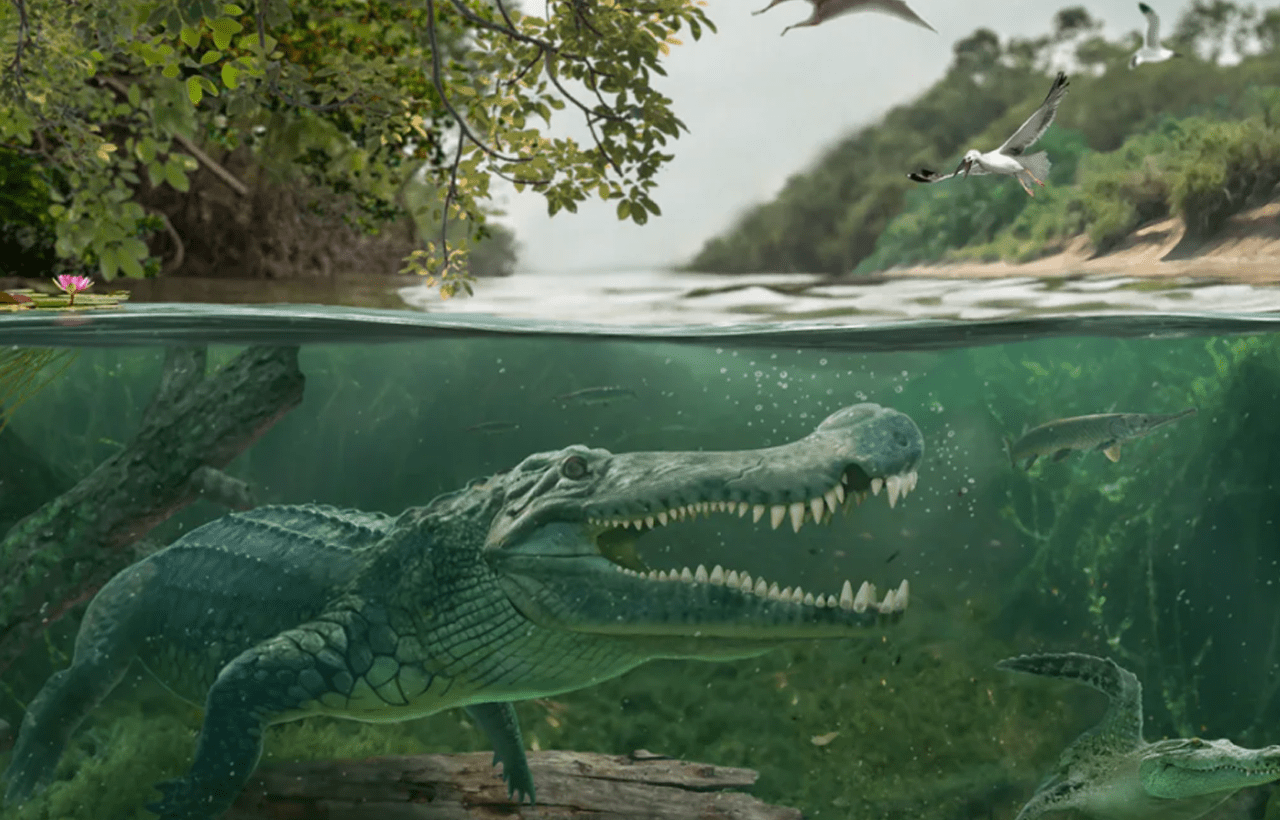
A long-lost giant once ruled the rivers and estuaries of ancient North America—a predator so massive and fearsome, it could take down dinosaurs. Meet Deinosuchus, a prehistoric beast with banana-sized teeth, an alligator-like snout, and one surprising advantage that helped it thrive: saltwater tolerance.
Stretching up to 26 feet long—roughly the size of a school bus—Deinosuchus was one of the largest crocodilians to ever exist. This predator lurked in the waterways between 82 and 75 million years ago, at a time when the continent was split in two by a vast inland sea. New research is now shedding light on how this monstrous reptile became such a dominant force.
Not Just a “Bigger Alligator”
Although its nickname, the “terror crocodile,” suits its intimidating appearance, Deinosuchus was often assumed to be a close relative of modern alligators. But new fossil evidence and DNA analysis are flipping that assumption on its head.
Scientists now believe Deinosuchus wasn’t part of the alligator family tree after all. Instead, it likely branched off much earlier, retaining a key evolutionary trait that set it apart: salt glands. These organs, present in modern crocodiles but not in alligators, allow reptiles to process and excrete salt—meaning Deinosuchus could comfortably venture into salty waters that its freshwater-reliant cousins couldn’t.
That ability may have been the secret to its success. With rising sea levels during the Late Cretaceous and the presence of the Western Interior Seaway dividing the continent, salt tolerance allowed Deinosuchus to cross into new territories, populating both eastern and western shores.
Built for the Kill
This predator didn’t just travel far—it ruled wherever it went. With a skull shaped like a massive battering ram and filled with terrifying teeth, Deinosuchus left behind bite marks in dinosaur bones that tell a grisly story of ambush, attack, and possibly scavenging.
Researchers believe that it occupied marshy ecosystems teeming with large prey, and based on its size and fossil evidence, it fed on just about anything it wanted. “No one was safe in these wetlands when Deinosuchus was around,” said Dr. Márton Rabi, a paleontologist at the University of Tübingen and lead author of the study.
A Mystery Solved
For years, scientists puzzled over how a presumed alligator-relative could be found on both sides of the ancient seaway. Alligators are strictly freshwater creatures, so how did Deinosuchus cross over?
The new study, published in Communications Biology, solved the mystery by reassessing its evolutionary lineage. Deinosuchus wasn’t an alligator at all—it was something else entirely. By analyzing “missing link” fossils and integrating molecular data from modern crocodilians, researchers reconstructed a new crocodilian family tree that repositions Deinosuchus as a salt-tolerant outlier.
This changes more than just labels—it reshapes our understanding of crocodilian evolution. Traits like saltwater tolerance may have been widespread in ancient crocodile-like species, only later lost in modern alligatoroids.
Giant Crocs Were the Norm
It turns out that Deinosuchus wasn’t even that unusual for its time. Throughout the last 120 million years, giant crocodilians have evolved over a dozen times independently, even during colder climatic phases like ice ages. While today’s crocs rarely reach those legendary lengths, records from as recently as the 19th century speak of individuals stretching 23 feet or more.
In the end, Deinosuchus wasn’t just a “greater alligator”—it was something far more formidable: a relic of evolutionary power, ecological flexibility, and prehistoric dominance.
So the next time you think of apex predators from the age of dinosaurs, don’t forget this salt-tolerant monster lurking in the shallows. The “terror croc” was very real—and no one in its domain was safe.
 IPSA SCIENTIA POTESTAS EST